Dear ,
Viktor Orbán wrote the modern autocrat’s playbook:
Capture 80% of the media space. Tilt the electoral system in your favour. Use state power to strengthen party power. Reward loyalists. Punish critics. Make change feel impossible.
For democratic opposition forces, it was a nearly impossible campaign landscape.
Yet, Orbán lost.
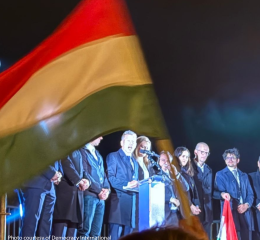
I was on the ground in Hungary as an election observer. Those days ahead of the election felt like a country holding its breath. After years in which Orbán’s rule felt permanent, many people were wondering whether election day would go smoothly at all. The surprise was not only that Péter Magyar won, as the appetite for change was clearly there, but that he won by such a landslide - and that Orbán actually conceded defeat.
The Hungarian election should be studied far beyond Budapest. Here are three lessons for democrats everywhere.
Firstly, civic turnout is the autocrat’s enemy. Hungary saw nearly 80% turnout, the highest in Hungarian history. Autocrats thrive on apathy and cynicism. They thrive when people withdraw and assume nothing can change. They benefit from low expectations and acceptance of the status-quo.
But when citizens believe their voice is important, even heavily tilted systems become vulnerable.
That is what happened in Hungary. The biggest threat to deep power is often not an ideology. It is participation itself.
Secondly, civil society stayed organised. Hungary’s independent media, NGOs, watchdogs, and civic actors worked for years under extreme pressure and nearly impossible conditions. They were attacked, smeared, doxxed, financially squeezed, and politically targeted.
Still, they kept up their work. Investigative journalists kept exposing corruption. NGOs kept defending rights. Democracy groups kept organising. Independent voices kept informing the public.
Even though Hungary’s democratic space was weakened, it was not fully extinguished. That’s important because when political openings finally come up, it only works if enough civic life survived to meet the moment.
Thirdly, corruption eventually breaks the model. Even autocrats need things to go well. They need roads fixed, hospitals functioning, prices stable, and public services working. But because corruption eats at capacity, they will fail.
When power is organised to enrich insiders, reward cronies, and protect those at the top, society will always pay the price. That means weaker healthcare, poorer services, slower growth, rising frustration, lost opportunities.
That is the weakness of authoritarian politics. It is a government for the megarich and powerful.
Democracy, for all its current noise and frustration, remains the better model because it is more accountable, more adaptive, and more capable of creating broad prosperity.
A country with real elections, independent media, independent NGOs, and meaningful citizen participation will always have a stronger long-term future than a country that is run for those at the top. A system for the megarich and corrupt can never deliver for the greater society.
Even Europe’s worst autocrats cannot escape that reality forever.
That is why we have been seriously underestimating democracy.
P.S. Read our election observation report here. |